Back to Blog
Technology
The Engine of Growth: Fintech and Mobile Money
Artificial Intelligence: The New Frontier
Artificial Intelligence stands as the most transformative technology on the horizon for Africa. Recognizing its potential, the African Development Bank, in partnership with the UN Development Programme, has unveiled an ambitious $10 billion AI initiative aimed at accelerating digital transformation and ensuring Africa becomes a producer, not merely a consumer, of AI technologies. This plan will fund digital skills training, research centers, and startups developing locally relevant AI solutions across critical sectors like healthcare, agriculture, and education.
Challenges on the Road Ahead
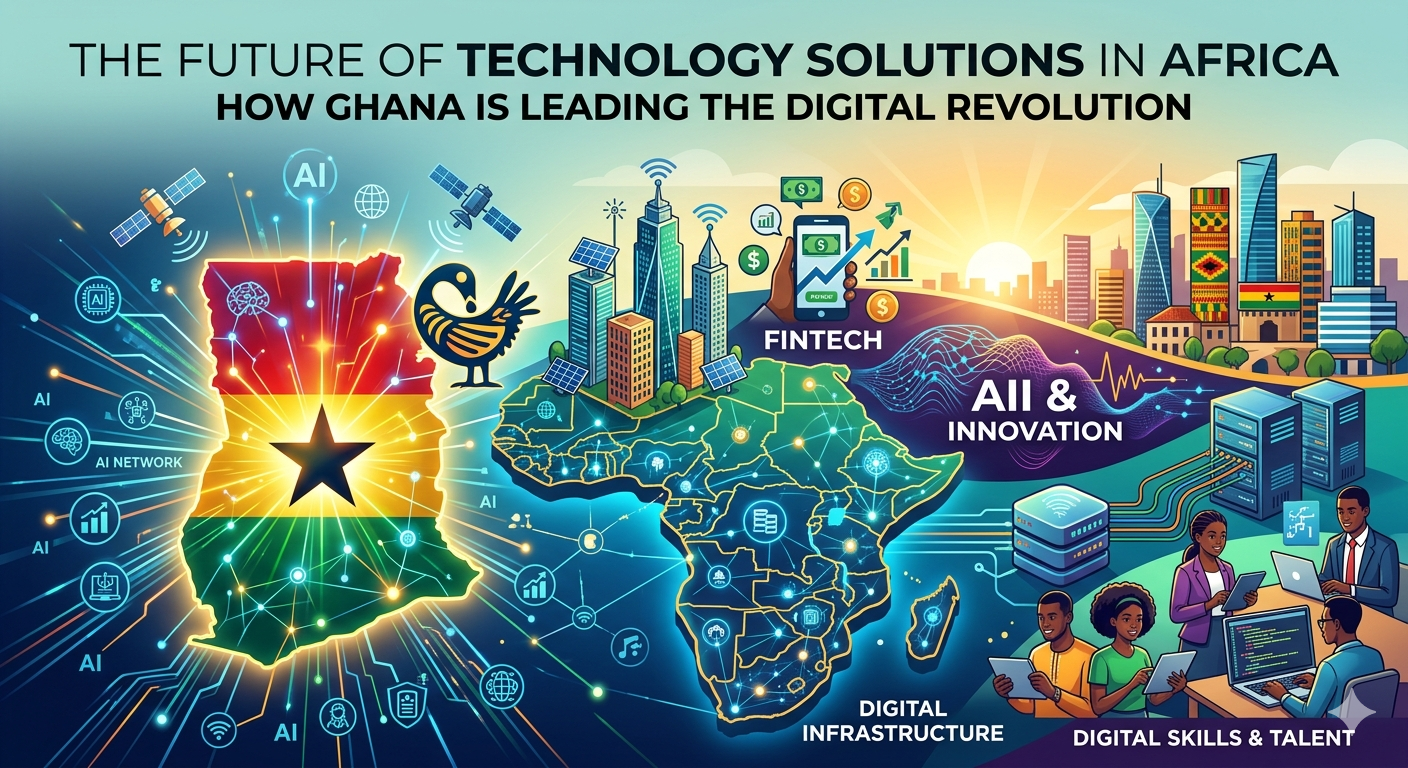
The Future of Technology Solutions in Africa: How Ghana is Leading the Digital Revolution
Africa is experiencing a technology revolution. From fintech to agritech, the continent is embracing innovation at an unprecedented pace. Here's what's driving this transformation.
BR
Bright Lloyd Aduko
April 19, 2026
5 min read
The narrative surrounding Africa has fundamentally shifted. No longer seen solely through the lens of development challenges, the continent is rapidly being recognized as a burgeoning hub of digital innovation and technological solutions. Across the region, from fintech breakthroughs to cutting-edge artificial intelligence (AI) infrastructure, Africa is not just adopting global tech trends; it is creating its own. At the heart of this transformation is Ghana, a West African nation emerging as a formidable technology powerhouse. This post explores the key trends and monumental shifts defining the future of technology in Africa, with a spotlight on Ghana’s strategic rise.
The Engine of Growth: Fintech and Mobile Money
The driving force behind Africa’s tech ascent is undeniably its financial technology sector. Fintech solutions have democratized access to financial services, leapfrogging traditional banking infrastructure. The numbers are staggering. Africa’s mobile money ecosystem has surpassed US$1.1 trillion in annual transactions, with 33% of adults in Sub-Saharan Africa now actively using mobile money services, contributing approximately 5% to the region’s GDP. This represents a 28% year-over-year growth, solidifying mobile money as the backbone of the continent’s digital economy.
This momentum is expected to accelerate. The embedded finance market in Africa is projected to grow by 11.2% annually, reaching US$13.2 billion by 2025, driven by innovation in payments, lending, and insurance. As the continent’s digital financial ecosystem matures, we are seeing a clear shift from connectivity-led models to compute- and AI-driven demand, setting the stage for the next wave of technological solutions.
Artificial Intelligence: The New Frontier
Artificial Intelligence stands as the most transformative technology on the horizon for Africa. Recognizing its potential, the African Development Bank, in partnership with the UN Development Programme, has unveiled an ambitious $10 billion AI initiative aimed at accelerating digital transformation and ensuring Africa becomes a producer, not merely a consumer, of AI technologies. This plan will fund digital skills training, research centers, and startups developing locally relevant AI solutions across critical sectors like healthcare, agriculture, and education.
Furthermore, there is a strong push for "AI localisation." Policymakers and entrepreneurs are moving beyond the adoption of foreign tools to developing local data ecosystems, language models that reflect Africa’s linguistic diversity, and AI tools designed for specific local challenges in agriculture, public health, and financial inclusion. This drive for "digital sovereignty" is a defining theme, with governments seeking to ensure data hosting and AI systems are under African ownership.
Building the Future: Digital Skills and Infrastructure
For technology solutions to thrive, a skilled workforce and robust digital infrastructure are non-negotiable. Across the continent, there is a massive push to bridge the digital skills gap. Initiatives like the partnership between Blossom Academy and Digital Africa are providing fully funded training in high-demand fields such as data analytics, machine learning, and MLOps to young professionals in Ghana, Rwanda, and Nigeria. The goal is to create a job-ready, local talent pipeline so that African startups no longer need to look abroad for key digital roles.
This focus on human capital is complemented by massive investments in digital infrastructure. The shift from basic connectivity to advanced cloud and compute capacity is well underway. This technological evolution was a central theme at the Africa Tech Festival 2025, where over 15,000 leaders convened to discuss the continent’s move toward enterprise-scale digital infrastructure, responsible AI, and regional policy alignment.
Spotlight on Ghana: A Rising Tech Powerhouse
While many African nations are making strides, Ghana is positioning itself as a beacon of technological ambition. The country’s national economic development is driven by the "Digital Ghana Agenda," which prioritizes ICT infrastructure, digital identity, and financial inclusion as core pillars of growth. This framework is already yielding results: mobile penetration exceeds 130%, and more than 80% of adults now use mobile money services, with total transaction value reaching approximately $300 billion.
The government’s forward-looking priorities, as articulated by the Minister for Communications, Digital Technology and Innovation, Hon. Sam George, include strengthening AI competitiveness, expanding digital job creation, and accelerating modernized public digital services. This vision is being backed by concrete action:
- Ghana Digital Acceleration Project (GDAP): A strategic partnership with the World Bank, GDAP is a multi-year initiative reviewed in late 2025, focusing on digital inclusion, modernizing government services, and transforming strategic sectors like health, education, and agriculture.
- 1BillionInnovationandAIHub: In a landmark 1BillionInnovationandAIHub:∗∗In a landmark 1 billion deal with the UAE, Ghana will build what is billed as Africa’s largest integrated innovation and AI hub in Ningo-Prampram. The project includes
400millionforhigh−performanceAIinfrastructure,400millionforhigh−performanceAIinfrastructure,350 million for digital infrastructure (including 5G and a hyperscale data center), and $250 million for talent and capital formation, aiming to attract and scale up 100 AI startups by 2030. - Continental Fintech Leadership: The Bank of Ghana has announced plans to launch a continental fintech sandbox, a national innovation hub, and a separate legal framework for fintech regulation, positioning Accra as a regional digital finance hub and signaling a shift toward more formalized oversight of digital finance.
Challenges on the Road Ahead
Despite the immense potential, significant challenges remain. Persistent gaps in digital infrastructure, such as reliable connectivity and advanced computing resources, are unevenly distributed. A shortage of skilled talent can slow progress, leaving less-prepared economies behind. Furthermore, governance gaps and the need for harmonized cross-border policies on data protection, AI ethics, and cybersecurity are critical issues that require urgent attention to ensure inclusive and sustainable growth. Successfully navigating these challenges will determine whether technology solutions translate into broad-based economic gains.
TLDR
The future of technology solutions in Africa is not a distant dream; it is being written today. The continent is on the cusp of a digital renaissance, driven by fintech inclusion, AI innovation, and massive investment in infrastructure and skills. As nations like Ghana lead with strategic vision and bold, multi-billion dollar investments, the message is clear: Africa is ready to compete on the global digital stage. For businesses, investors, and tech enthusiasts, the time to pay attention is now, because the next generation of world-changing technology solutions is emerging from Africa.